
Background
My previous project was NBA-dle, and while I was building it, I saw a bigger idea that had logins, more puzzles, historical play, etc. I spent weeks on this, overengineered, and never launched. Then I had a newborn child and a couple freelancing contracts so I had no free time and this project went into abeyance. But here we go again! I figured why not start where we left off.
What I Built
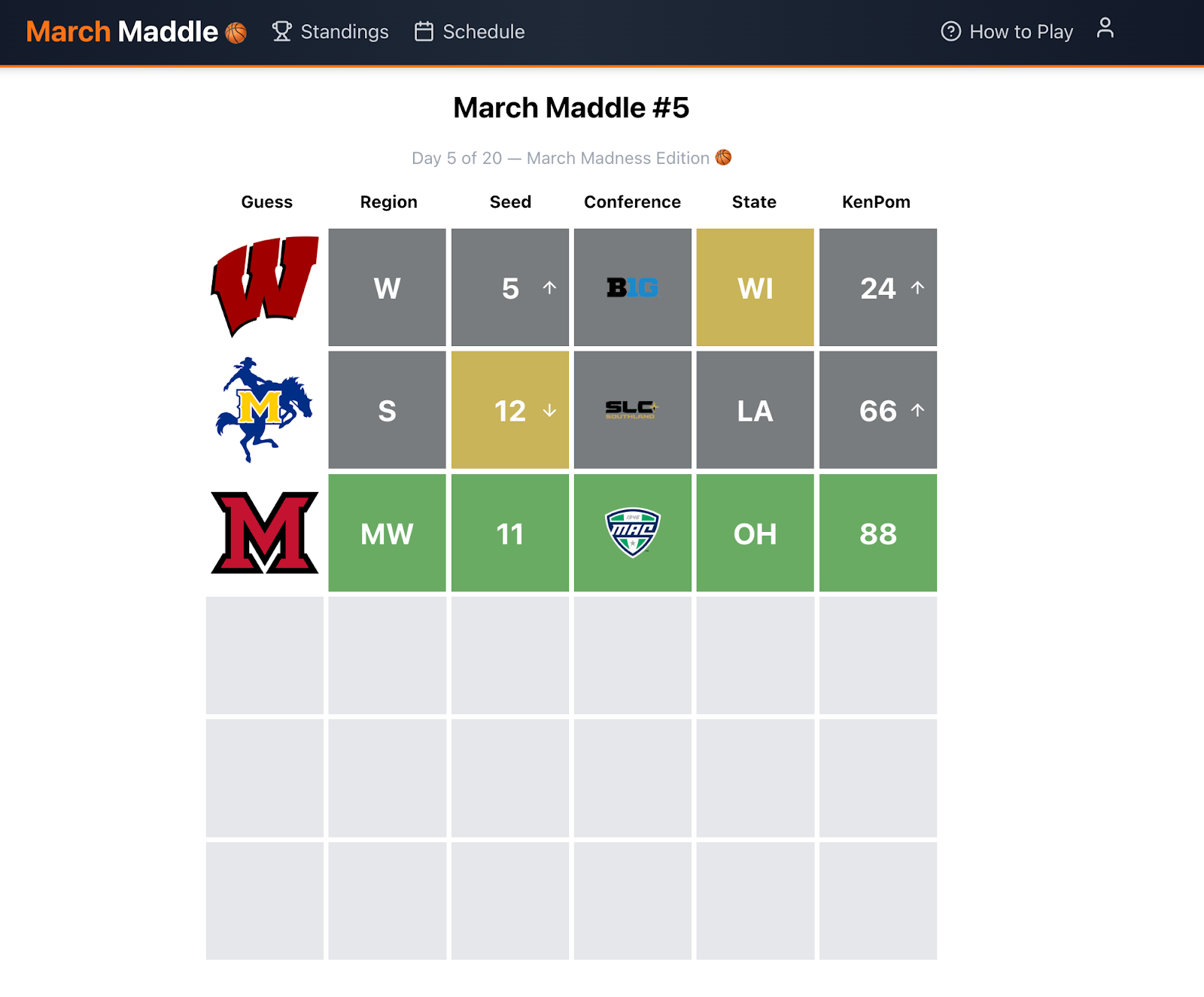
It’s NBA-dle but with a March Madness twist and a few upgrades:
Limited Time: I’m only going to maintain this through the end of March Madness (instead of indefinitely like NBA-dle).
Users Accounts: you can sign in with Gmail and create a username which tracks your usage. This also gives the following bonuses:
Streaks: if you get more than one game in a row, your game score will be higher.
Standings: you’ll be entered into global competition to see how your score for the season stacks up with everybody else.
Historical Games: you can play historical games (not just that day’s game).
Game Scores: Points are awarded for streaks, solving quickly, and playing the day a puzzle drops.
Refactored Backend: I did a lot to rewrite the backend so I can quickly add new puzzle types in different verticals.
What I Learned
2026 Agents Can Do What 2025 Agents Couldn’t
Agents are improving in lots of different dimensions, but what’s most exciting is not when they can do things faster or longer, but when they can do things they previously couldn’t. I had two examples in this project.
Framework Refactor: NBA-dle was written in a Javascript framework called Vite but I prefer Next. I tried to do a Next migration in 2025 but it was too painful with agents, and doing it myself would have taken hours to get right, so I abandoned it. For MarchMaddle, Claude Code was able to knock this out in <10 minutes.
Data Collection: when I made NBA-dle, I had to do a lot of manual scraping and data pipelining work myself that was tedious and took hours. When building MarchMaddle, I was able to do all the scraping, storage, and database with a few prompts.
In all. Claude Code saved me at least 4-6 hours of work compared to what this would have taken last year.
Agents Can’t Solve All Problems
If I’d fully trusted the agents to build this product, I would have never launched. I ran into a bug where the user creation and authentication logic didn’t work right, and neither Claude nor Codex could figure it out. They kept spinning in circles and repeatedly trying the same solutions with no resolution. The bug was related to a flawed AuthContext component and I decided we should simply rip that out and rebuild without it. Claude initially refused because “that would take days of work and we’re 5 minutes away from solving this” but I told it to go ahead and do the rewrite. Instead of days, it took about 5 minutes and after it was done, the user login flow worked as expected.
This was the first time I’ve had agents hit a wall like this in months and I’m surprised that it couldn’t resolve on its own. Maybe there’s a creativity or novel problem-solving aptitude these things still lack? Whatever the reason, it reminded me of how Kirk defeated Khan through experience and not intelligence.
Skills Are Cool and Going to be Huge
Garry Tan (the current head of YC and technically my former boss) released a series of skills related to building an early stage product called gstack. One of the skills is called office-hours, and I used it a lot to refine my thinking when creating this MVP. Most of my Claude Code usage is me pushing work onto the agents, but the office-hours skill reverses this and has the agent push me on my thinking, what I’m trying to do, my goals, etc.
Skills are exploding in popularity. As of writing this post, gstack has 47K stars and superpowers (a repo of technical-focused skills) has 112K stars. In the future, instead of releasing eBooks or seminars, I hope elite practitioners condense their learnings into a set of skills that one could directly inject into the project like Neo learning kung fu or Trinity learning to fly a helicopter. I’ll write a longer post but I could see this being for company management what open source was for software.
You Have 3 Seconds to Hook a User
When I shared this product to get feedback, multiple friends said “oh cool man! I’ll definitely check this out!” and they clearly never used it. I’d follow up and ask what happened and most of the time the response was “I didn’t know how to use it” despite the fact that there’s text that says “Enter your guess here…” and a modal that explains how to play.
Do I have shitty friends? Yes. But the larger point is that the dopamine economy is insanely efficient. If you’re building something for consumers and they don’t get a dopamine hit or can see how they’ll get a dopamine hit within 3 seconds, you’re screwed.
Distribution Is the Hardest Part
In the military, there’s a saying “amateurs talk strategy, veterans talk logistics.” In startups, it’s “first-time founders focus on product, repeat founders focus on distribution.” In the GenAI world where it’s trivially easy to iterate and improve products, actually getting a compelling product into somebody’s hands, having them use it, and keeping them exposed is still very hard and something I’m not good at. The reality is that an awesome product that nobody sees will be less successful than a mediocre product in front of lots of people. In fact, an excellent product that nobody can see is effectively identical to having no product at all.
What’s Next
My priority for my next project is to research distribution before building the product. Because I rewrote the backend of this product to flexibly handle new puzzle types, I can pivot to whatever vertical has the most promising distribution angle. I’m going to reach out to different people to see if they’d be interested in collaborating, and if they are, tweak the product to fit their niche! If you don’t like this format but would like other verticals, let me know!